
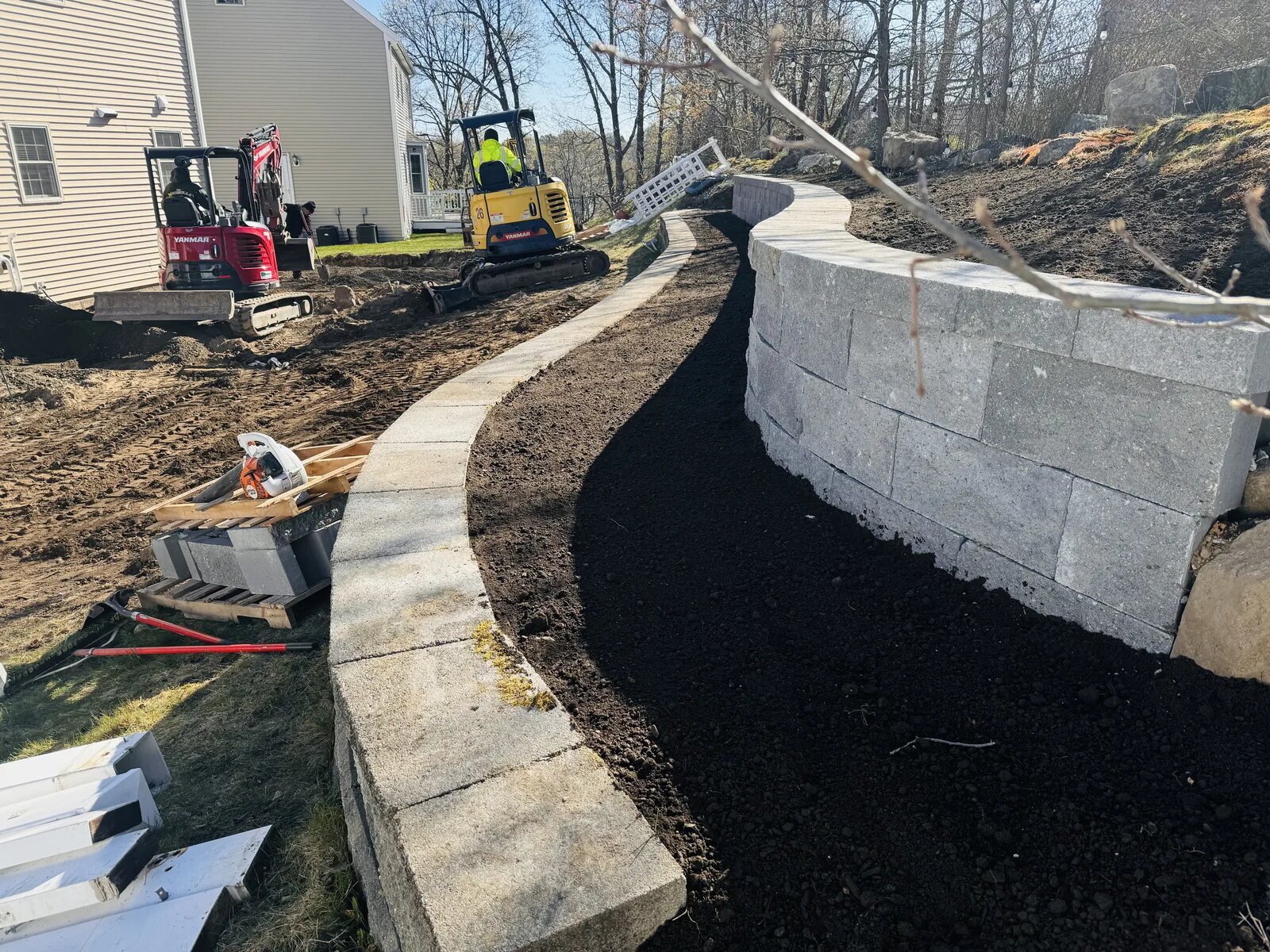
Two patios of the same size in the same town can differ in price by a wide margin, and the pavers are rarely the reason. Paver patio cost in Massachusetts is driven by what happens under the surface, how equipment reaches the yard, and where the water goes when it rains.
We would rather explain the cost drivers than quote a number we cannot stand behind. Every yard is different, and an honest range comes from a site visit, not a web page.
The five things that actually set the price
Square footage matters, but it is only the starting point. These five items decide where in the range a project lands.
| Cost driver | Low impact | High impact |
|---|---|---|
| Base depth | Well drained soil, foot traffic only | Clay soil, vehicle load, deeper gravel in lifts |
| Site access | Wide driveway, machine reaches the yard | Narrow side yard, material moved by wheelbarrow |
| Demolition | Bare lawn area | Old concrete slab or patio to break out and haul |
| Drainage work | Yard already sheds water | Regrading, drain lines, downspout tie ins |
| Pattern and cuts | Running bond, straight edges | Herringbone, curves, borders, inlays, many cuts |
Why base prep is the biggest line item
The base is compacted gravel installed in lifts, and it is the part that keeps the patio flat through New England winters. A thin base is invisible on day one and obvious after the second spring.
If a bid is far cheaper than the others, the base is usually where the money was removed.
How access changes labor
A back yard a machine can reach cuts labor dramatically. When the only path is a three foot gate, every ton of gravel and every pallet of pavers moves by hand, and that time is real.
This is common on older lots in Quincy, Chelsea, and parts of Boston where houses sit close together. It does not make a project unaffordable, it just changes the labor math and we say so up front.
Material choices and what they change
- Standard concrete pavers, the widest range of colors and the most economical
- Premium textured pavers, thicker units and more consistent color
- Permeable pavers, useful where water needs to soak in rather than run off
- Natural bluestone, cut stone with a distinct New England look and a higher material cost
- Border and accent courses, a small material add that changes the finished look
If you are torn between cut stone and manufactured units, our bluestone versus pavers comparison walks through how each ages here.
Extras that get added mid project
These are the items homeowners often add once the space is staked out and they can see it. Deciding early keeps the price stable.
- Seating wall along one or two edges
- Fire pit built into the layout
- Steps or a landing connecting the patio to a door
- Low voltage lighting in the wall caps or along a path
- A walkway tying the patio to the driveway
- Bed prep and mulch around the finished edges
What a real estimate should show you
A written estimate should name the excavation depth, the base material, the compaction method, the edge restraint, the joint sand, and how water leaves the area. If those are missing, you cannot compare two bids.
It also helps to know the sequence before you sign. Our post on what to expect from a stonework project walks through each stage in order.
For a broader look at masonry budgeting, our post on stonework and masonry cost in Boston covers walls, veneer, and steps the same way.
Ways to control the budget without cutting quality
- Size the patio to how you actually use it instead of the largest footprint
- Keep the shape simple, since curves and inlays add cutting time
- Choose a standard paver and spend the difference on the base
- Phase the project, patio first, then wall or fire pit next season
- Handle your own furniture moving and small plant relocation
Ready for a real number? Read how we build on our paver patio service page, then call (857) 880-6609 and we will measure the space and put it in writing.
Frequently asked questions
- Why do paver patio quotes vary so much?
- Because the invisible work varies. Base depth, compaction, drainage, and edge restraint are where two bids differ most, and none of it shows in a photo. Ask each contractor to write those items on the estimate and the comparison becomes fair.
- Is a paver patio cheaper than a concrete slab?
- It depends on the scope, and the honest answer is that they compete closely on many jobs. Pavers cost more in labor and less in repair, since individual units can be lifted and reset. Concrete is simpler up front and harder to fix when it cracks.
- Does patio size change the price per square foot?
- Usually yes, in your favor. Mobilization, excavation setup, and equipment costs get spread across more area on a larger patio, so the per foot number often drops as the project grows.
- Do I need a permit for a patio in Massachusetts?
- Rules vary by town and by what the patio is near, such as a wetland, a slope, or a property line. We confirm current local requirements before starting and handle the filing when one is needed.
- How long does a paver patio take to install?
- Most residential patios run several days to about two weeks. Demolition, drainage work, and hand carrying material through a narrow yard are the three things that stretch the schedule most.
Planning a demolition project in Boston, Massachusetts and nearby towns? Learn more about our demolition service or get in touch directly.
Call Bear Valley Stonework & Landscape at (857) 880-6609 for a free estimate anywhere in Quincy, Milton, Braintree, Weymouth, Hingham, Newton, Brookline, and the rest of Greater Boston.