
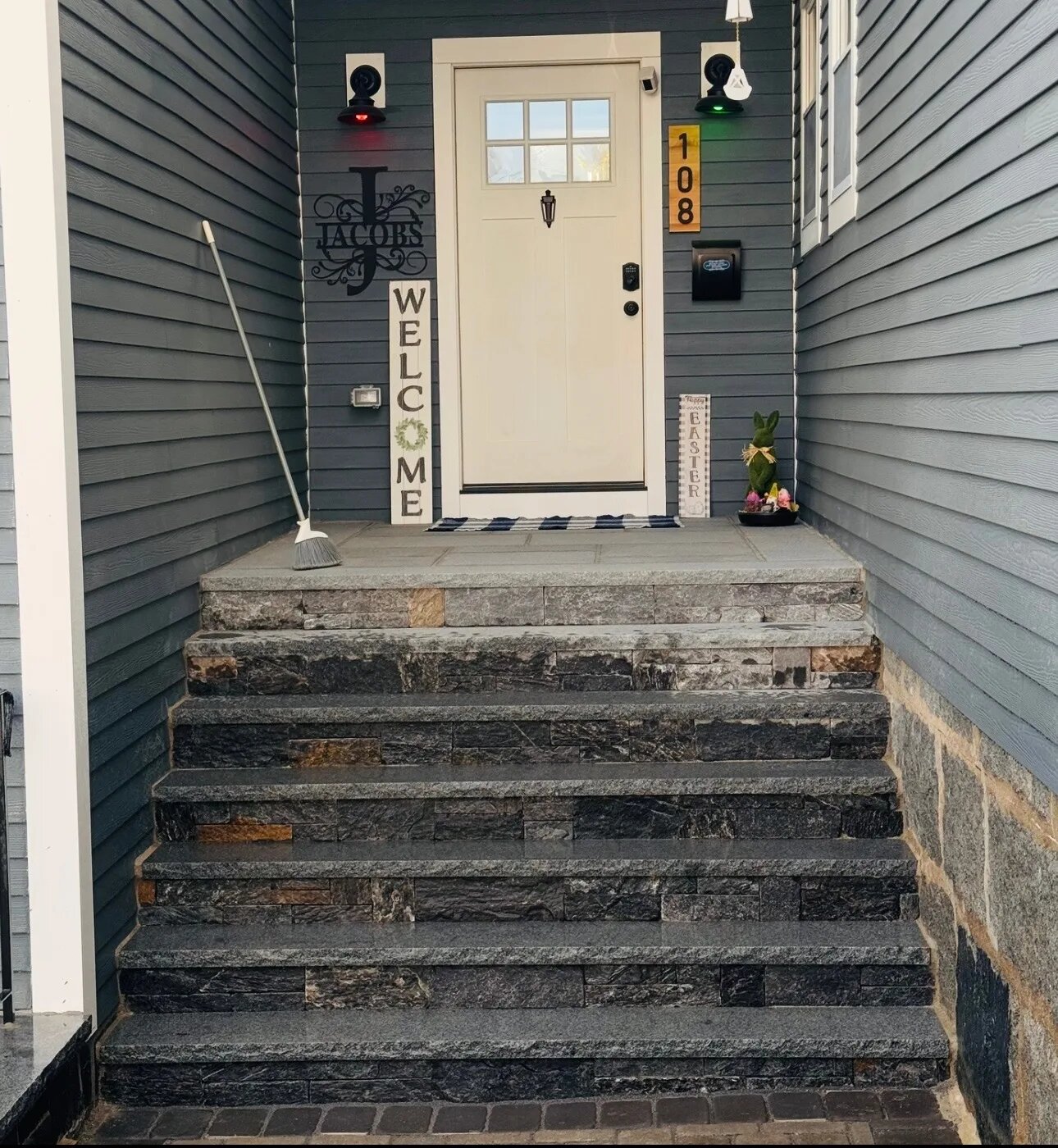
Most failed retaining walls in Quincy, MA did not fail because of the stone. They failed because water had nowhere to go. On the sloped lots around Squantum, Houghs Neck, and West Quincy, drainage behind the wall is the part that decides whether it stands for decades or leans in three winters.
We build walls all over Quincy, from short seat walls in Wollaston yards to terraced walls holding a full back slope. The design questions are always the same three: how much soil is the wall holding, where does water go, and what does the finished wall need to look like next to the house.
What a retaining wall actually does
A retaining wall holds back soil and controls grade. That is a structural job, not a decorative one, and the load behind the wall grows fast as height increases and as soil gets saturated.
That is the difference between a retaining wall and a garden wall. We broke that down in detail in our post on stonework versus retaining walls, which is worth reading if you are not sure which one your yard needs.
Material options for Quincy properties
There is no single best material. There is a best fit for the height, the look of the house, and the budget. Quincy has its own advantage here, since granite has been quarried in West Quincy for generations and reads as natural on these streets.
| Material | Best for | Look | Notes |
|---|---|---|---|
| Natural fieldstone | Traditional homes, terraced yards | Hand fit, irregular, timeless | Slowest to build, highest craftsmanship |
| Granite block | Coastal and historic Quincy lots | Heavy, gray, local character | Very durable, needs equipment to set |
| Segmental concrete block | Straightforward grade changes | Uniform, many colors | Fastest install, engineered courses |
| Boulder wall | Large slopes, rural edges | Rugged and natural | Needs space at the base, machine set |
| Poured concrete with veneer | Tight spaces, tall walls | Clean face, custom stone finish | Structural core plus a stone face |
Drainage is the whole ballgame
Behind a properly built wall there is gravel, a perforated pipe, and a way for water to exit. Without that, rain and snowmelt saturate the soil and push on the wall with far more force than dry soil does.
Add freeze thaw to saturated soil and you get the bulge you see on so many old walls. Water expands as it freezes, and that pressure has to go somewhere.
What we install behind the wall
- Compacted gravel base below the first course, set below finished grade
- Free draining crushed stone backfill against the back of the wall
- Perforated drain pipe at the base with a positive outlet, not a dead end
- Filter fabric so soil fines do not clog the stone over time
- Grading above the wall so surface water runs away, not into the backfill
Permits, height, and property lines in Quincy
Many Massachusetts communities require a permit once a wall passes a certain height, and taller walls often need an engineer's design. Rules vary by town and by where the wall sits relative to a lot line, a wetland, or a public way.
We check the current requirements with the city before we start and handle the paperwork. If your project sits near a wetland resource area, the Massachusetts Wetlands Protection Act may apply, and the state publishes the current program details at the Massachusetts wetlands protection program.
Signs an existing Quincy wall is in trouble
- The face bows outward in the middle, usually the first visible symptom
- Courses have separated or stones rock under hand pressure
- Soil or mulch washes out from behind the top course after storms
- Water seeps through the face days after rain has stopped
- The ground above the wall has cracked or dropped along the top edge
- Steps or a walkway next to the wall have tilted
If two or more of those apply, get eyes on it before winter. Our post on the signs you need stonework or masonry covers what each symptom usually means underground.
Repair or rebuild
A short section that has moved can often be taken apart and reset, provided the base and drainage below it are sound. When the base was never right, resetting stone just buys a season.
We tell you which one you are looking at after we see it. A rebuild costs more up front and stops the cycle of patching.
What the process looks like
We walk the site, measure the grade change, and talk through material and drainage. You get a written number with the base and drainage spelled out as line items, not buried in a lump sum.
See full details on our retaining wall construction service, or call (857) 880-6609 and we will come look at the slope.
Frequently asked questions
- How tall can a retaining wall be before it needs an engineer?
- Thresholds are set locally and by the wall design, and taller walls carry much higher soil loads. We confirm the current requirement with the city for your specific height and location before work begins, and we bring in engineering when the project calls for it.
- How long does a retaining wall take to build in Quincy?
- Short garden height walls often run a few days. Terraced or structural walls with excavation and drainage usually run one to two weeks, and access is the biggest variable on tight Quincy lots where material has to be moved by hand.
- Why did my old wall lean but my neighbor's did not?
- Almost always drainage and base depth. Two walls that look identical from the street can be built completely differently underground. Saturated soil behind a wall with no gravel and no drain pipe pushes hard, especially through freeze thaw cycles.
- Can a retaining wall fix a wet back yard?
- It can be part of the fix, but a wall alone does not move water. Grade correction, downspout tie ins, and a drain outlet do that work. We look at the whole water path before recommending a wall as the answer.
- Do you work in every part of Quincy?
- Yes, from Wollaston and Squantum to Houghs Neck and West Quincy. We are based nearby and are in the city most weeks, and we do not charge travel within our service area.
Planning a excavation project in Boston, Massachusetts and nearby towns? Learn more about our excavation service or get in touch directly.
Call Bear Valley Stonework & Landscape at (857) 880-6609 for a free estimate anywhere in Quincy, Milton, Braintree, Weymouth, Hingham, Newton, Brookline, and the rest of Greater Boston.