
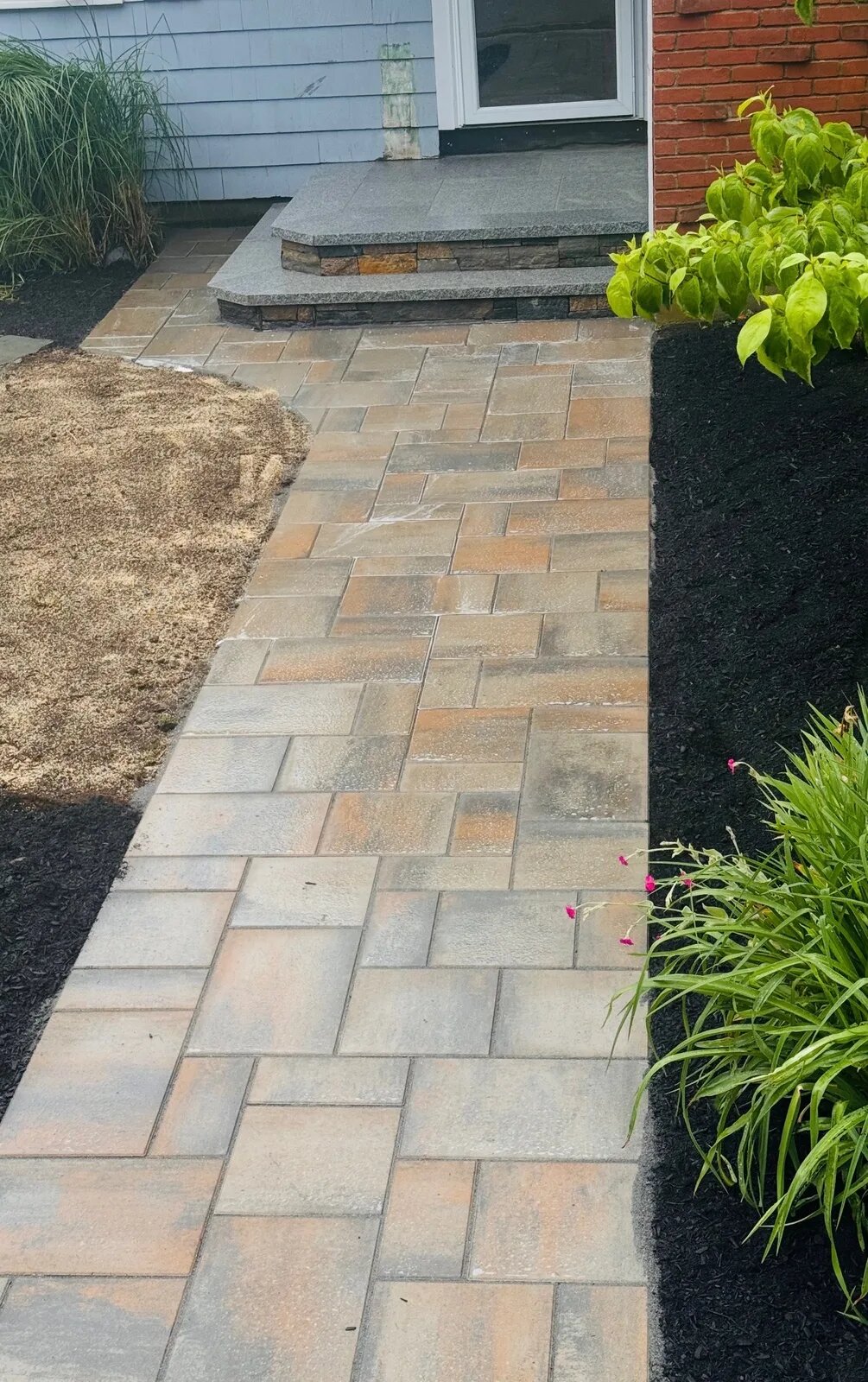
Water pooling in your yard after rain is a symptom, not the problem. The cause is almost always one of four things, which are roof water dumped in the wrong place, grade that runs toward the house, compacted or clay heavy soil, or a drain that no longer has an outlet.
Puddles in the lawn are annoying. Water sitting against a foundation is expensive, and around Greater Boston it is the call we get most after a heavy storm.
Diagnose it in one walk after the next rain
Go outside while it is still wet. Standing water tells you where it collects, but the useful information is where it comes from and where it fails to leave.
- Start at the downspouts and follow where each one discharges
- Look at the slope of the ground within ten feet of the foundation
- Note every low spot that holds water and how long it stays
- Check whether water is crossing a patio or walkway toward the house
- Find any drain grates or pipe outlets and see if they are flowing
- Look at the base of retaining walls for seepage or washed out soil
- Note which spots stay soft and mossy days after the rain stops
The four common causes and what each fix looks like
| What you see | Likely cause | Typical fix |
|---|---|---|
| Puddle right at a downspout | Roof water discharging at the foundation | Extend the downspout or tie it into a buried line |
| Water against the foundation wall | Grade slopes toward the house | Regrade so ground falls away from the building |
| Wide shallow puddles across the lawn | Compacted or clay heavy soil | Aeration, soil amendment, or a swale to move water |
| A soggy strip in one line | Buried drain with a blocked or missing outlet | Locate, clear, or rebuild the drain with a real outlet |
| Water pooling on a patio | Insufficient pitch or settled base | Lift and reset with correct slope, add edge drainage |
| Wet basement after storms | Any of the above concentrating water outside | Fix the exterior water path first, then reassess |
Downspouts first, always
Roof water is the largest single volume of water hitting your property, and it arrives concentrated in a few spots. Moving it away is the cheapest fix on this list and it solves a surprising number of yard puddles by itself.
Local soil and why South Shore yards stay wet
Much of eastern Massachusetts sits on glacial till, which mixes fine material with stone and drains slowly. Add decades of foot traffic and mowing over the same lawn and the top layer compacts further.
Low lying coastal areas around Quincy, Weymouth, and Hull also sit closer to a seasonal high water table, so the ground has less room to absorb a big storm. You can look up soil characteristics for a specific address through the USDA Web Soil Survey.
Fixes ranked by cost and disruption
- Extend downspouts, low cost and often immediate improvement
- Clear existing drains and outlets, low cost, sometimes the whole answer
- Core aerate and amend compacted lawn, moderate cost, gradual improvement
- Cut a swale to guide surface water, moderate cost, shapes the yard
- Install a French drain with a positive outlet, higher cost, handles volume
- Add a dry well where there is no place to daylight a pipe, higher cost
- Full regrading around the foundation, highest cost, permanent correction
What a French drain does and does not do
A French drain is a gravel trench with a perforated pipe that collects water and carries it somewhere else. The somewhere else is the part people skip, and a drain without a real outlet just relocates the puddle underground.
We plan the outlet before we plan the trench. On flat lots that can mean a dry well, and on sloped lots it usually means daylighting the pipe at a lower point.
Keeping it working is simple upkeep after that. Our landscaping maintenance guide for Massachusetts homes covers the seasonal checks that keep a drain clear.
Why this matters before winter
Saturated soil freezes and expands, which pushes on foundations, walls, and steps. Correcting drainage in fall means the fix gets tested by real rain and the ground goes into winter dry.
If a wall is already showing seepage, read our post on signs you need stonework or masonry and the freeze thaw protection checklist before the first hard freeze.
Standing water that will not go away? See our drainage solutions service or call (857) 880-6609 and we will find where the water is coming from before we dig anything.
Frequently asked questions
- How long should water sit in a yard after rain?
- Most healthy lawn areas drain within a few hours of the storm ending. Water that is still standing the next day points to compaction, a high water table, or a low spot with no path out, and water that sits for days needs a real fix.
- Is water near my foundation an emergency?
- It is not a same night emergency, but it is the problem to solve first. Repeated saturation against a foundation leads to seepage inside and to freeze pressure in winter. Start with downspouts and grade, since those are the fastest wins.
- Will a French drain fix my whole yard?
- Only if the yard has one clear water path and a place to send the water. Many wet yards need a combination, such as downspout extensions plus regrading plus a drain line. We look at the full path before recommending one piece of it.
- Can I just add topsoil to fill the low spots?
- Filling a puddle without changing where water goes usually moves the problem a few feet. Grading works when it is planned as a continuous fall away from the house toward an outlet, not as a patch on one dip.
- Do you handle both drainage and the hardscape repair?
- Yes. Drainage, excavation, grading, patios, and walls are all in house for us, so the drain and the surface above it get built as one plan instead of two separate visits.
Planning a irrigation & sprinkler systems project in Boston, Massachusetts and nearby towns? Learn more about our irrigation & sprinkler systems service or get in touch directly.
Call Bear Valley Stonework & Landscape at (857) 880-6609 for a free estimate anywhere in Quincy, Milton, Braintree, Weymouth, Hingham, Newton, Brookline, and the rest of Greater Boston.